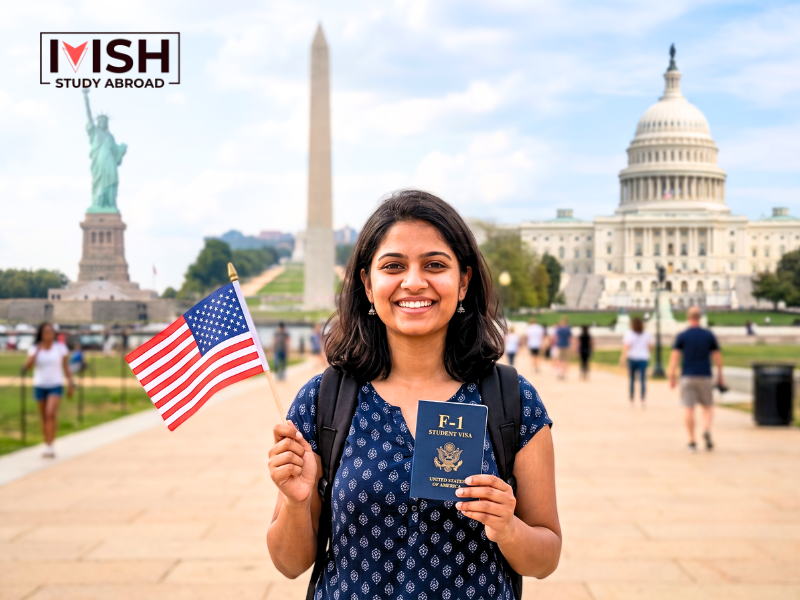
If you are planning to study in the United States for the Fall 2027 or Spring 2027 intake, the F1 visa USA process looks quite different from what students went through even two years ago. New rules on fixed admission periods, a shorter grace period, expanded social media screening and a fresh set of visa fees have all landed within the same twelve-month stretch.
This guide is specifically for Indian students who want a clear, current and honest picture of the F1 visa USA journey in 2027. It walks through eligibility, the full F1 visa application process, interview preparation, the new admission rules that took effect on 15 September 2026 and the real cost of studying in America. According to figures shared by the Union Ministry of Education in the Rajya Sabha, over 626,000 Indian students went abroad for higher education in 2025 and the United States continues to be one of the top three destinations for this group despite tighter visa scrutiny.
Whether you are a final-year undergraduate, a working professional applying for an MBA or a masters aspirant chasing a STEM degree, understanding the F1 visa requirements for Indian students before you apply saves you months of avoidable stress.
What Is An F-1 Student Visa?
The F1 visa USA is a non-immigrant visa issued by the United States government to international students who wish to pursue full-time academic study at a school certified by the Student and Exchange Visitor Program (SEVP). It covers a wide range of programmes, including undergraduate degrees, master’s programmes, MBAs, PhDs and many full-time academic or diploma programmes offered by eligible universities, colleges and other institutions.
The F-1 visa is different from the J-1 exchange visitor visa and the M-1 vocational student visa. Each visa category has its own rules governing study, employment, dependents and how long a student can remain in the United States. Students on F-1 status are generally expected to maintain full-time enrolment, make normal academic progress and follow the conditions of their status throughout their studies. After completing their programme, they may leave the United States, begin an authorised period of practical training or take another permitted immigration route.
Until 2026, most F-1 students were admitted under a system known as Duration of Status (D/S). This allowed eligible students to remain in the United States for the duration of their authorised programme, provided they maintained their status and complied with the applicable rules, rather than having a specific admission end date recorded on their Form I-94.
This system changed in 2026. Under the new rules, eligible F-1 students entering the United States from September 15, 2026, are generally admitted for a fixed period instead of Duration of Status. This is an important change for students planning to apply for the Fall 2027 or Spring 2027 intake and we explain what the new admission period, extension process and related changes mean later in this guide.
Students who want personal guidance through this process can speak with an experienced USA study visa consultants in Vasai Virar, Mumbai team, such as iVish Study Abroad, since visa rules are now changing faster than most university websites can update their pages.
F1 Visa USA Requirements For Indian Students
Meeting the F1 visa requirements for Indian students is one of the most important steps in the application process and it starts well before the visa interview. From securing admission at an eligible institution and obtaining your Form I-20 to preparing your financial and academic documents, each part of the application needs to be consistent and properly documented.
If you are researching how to study in Canada January intake programmes without missing early scholarship rounds, the honest answer is that you should treat April to August 2026 as your active research and shortlisting period, not just a waiting phase. University portals typically go live in this window and some institutions release their January application forms as soon as their September intake closes.
Eligibility
- Acceptance into a SEVP-certified U.S. school or university for a full-time academic programme.
- A valid Form I-20 issued by that institution after you confirm your admission.
- Sufficient funds to cover at least the first year of tuition and living costs, with a credible source for the remaining years.
- Strong ties to India that show you plan to return once your programme and any authorised training period ends.
- No disqualifying immigration history, such as a prior visa violation or an unresolved overstay.
Academic Requirements
US universities look at your academic transcripts, standardised test scores where required and English proficiency scores. For undergraduate admission, most universities expect a consistent academic record through Class 12, along with SAT or ACT scores for competitive programmes. For masters and MBA applicants, a recognised bachelor’s degree with a minimum GPA equivalent, along with GRE or GMAT scores where the programme still requires them, forms the baseline.
Close to 60 per cent of US universities have now waived the GRE for masters admissions in fields such as engineering, business and public health, though this varies significantly by department, so always confirm this directly with your target programme. English proficiency is usually demonstrated through IELTS, TOEFL or Duolingo English Test scores, with most universities asking for an IELTS band of 6.5 to 7.0 or equivalent.
Financial Requirements
This is where many Indian applicants can get tripped up. You are expected to show liquid funds, fixed deposits, education loan sanction letters or a combination of these, covering the first-year costs listed on your Form I-20. Consular officers may also look at how these funds were built up, so a large deposit made just weeks before your interview may require an explanation. A US student visa consultants in Vasai Virar team can help you identify such gaps and organise the required documents before your interview.
Officers may also look at your family’s overall financial situation, not just the bank balance. Your parent’s salary slips, income tax returns from the last two to three years, fixed deposit records and education loan documents can help show where the money is coming from. If your family’s money is spread across different bank accounts, make sure all the documents are organised and easy to explain before the interview.
Required Documents
- Valid passport with at least six months’ validity beyond your intended stay
- Form I-20 signed by you and your Designated School Official
- DS-160 confirmation page
- SEVIS fee payment receipt
- Visa appointment confirmation letter
- Academic transcripts, mark sheets and degree certificates
- Standardised test score reports, such as SAT, GRE, GMAT, IELTS or TOEFL
- Financial documents, including bank statements, fixed deposit receipts and loan sanction letters
- Passport-size photographs meeting US visa specifications
- Statement of purpose and admission or scholarship letters, where applicable
Meeting every item on this list is only one part. Presenting it in a way a consular officer can quickly understand is where most students actually lose points, which is why working with a US student visa consultants in Vasai Virar team early in the process tends to pay off during the interview stage.
F1 Visa USA Application Process From India
The F1 visa application process runs through a fixed sequence of steps and skipping ahead or getting the order wrong is one of the most common causes of last-minute panic among Indian applicants.
1. University Admission
Everything starts with a confirmed admission offer from a SEVP certified university. Applying to a realistic mix of universities based on your academic profile, budget and career goals, rather than chasing rankings alone, sets up the rest of the F1 visa process for USA from India for success.
2. Form I-20
Once you accept your offer and submit proof of funds to your university’s international office, the school issues your Form I-20. This document carries your SEVIS ID number and is the single most important paper in your entire application, so check every detail on it, including your name spelling and programme dates, the moment you receive it.
3. SEVIS Fee
Before you can book your visa interview, you must pay the I-901 SEVIS fee. As of 2026, the SEVIS fee for F-1 applicants stands at $350, paid directly through the official FMJfee.com portal. This is separate from your visa application fee and funds the system that tracks international students throughout their stay in the US.
4. DS-160
The DS-160 is the online nonimmigrant visa application form required for every F-1 applicant. It asks for your personal details, travel history, family background, education, work experience and social media handles used over the past five years. Since 2025, the US State Department has expanded its social media vetting for F, M and J visa applicants, asking many students to keep their profiles public for consular review rather than private. Answer every question on the DS-160 accurately, since any mismatch between this form and your interview answers is treated seriously.
5. Visa Fee
The nonimmigrant visa application fee, commonly called the MRV fee, is currently $185 for F-1 applicants. On top of this, most applicants now also pay a new $250 Visa Integrity Fee at the time their visa is issued, introduced under recent US legislation and collected directly at the embassy or consulate rather than in advance. This fee is technically refundable if you leave the US on time or change status legally, though the refund process is still being finalised, so budget for it as a real cost rather than a recoverable one.
6. Appointment
Once your SEVIS and MRV fees clear, you can schedule your visa interview at the nearest US embassy or consulate in India. Wait times for Indian applicants have grown noticeably longer since a temporary pause on new student visa interviews in mid 2025, so book your slot the moment your I-20 is in hand, ideally 90 to 120 days before your programme start date.
7. Interview
The consular interview is a short, direct conversation where an officer decides whether you qualify for the visa. This is covered in complete detail in the next section, since it is the single most decisive stage of the F1 visa application process.
8. Visa Decision
You will usually be told the outcome the same day, though some cases are placed under Section 221(g) administrative processing, which can add days or weeks. If approved, your passport with the visa stamp is returned to you through the visa application centre. If refused under Section 214(b), you can reapply, but only after addressing the specific reason for the refusal, since submitting an unchanged application again rarely helps.
A structured F1 visa process for USA from India built around these eight steps, rather than a rushed last-month scramble, is consistently what separates a smooth approval from a stressful last-minute rejection.
F1 Visa USA Interview - Questions, Preparation And Common Mistakes
Since October 2025, the State Department has rolled back most interview waivers, so nearly every F-1 applicant, including many renewals, must now sit through an in-person interview. Preparing for it properly is no longer optional.
Common Interview Questions
- Why did you choose this particular university and this specific course?
- Why not pursue this same programme in India?
- Who is funding your education and how did they earn this money?
- What are your plans once you complete your degree?
- Do you have relatives currently living in the United States?
- What was your undergraduate major and how does it connect to this new programme?
- How many universities did you apply to and why did you choose this one?
What The Officer Evaluates
A consular officer is not testing your English fluency or your general knowledge. Under Section 214(b) of the Immigration and Nationality Act, every applicant is presumed to have immigrant intent unless they prove otherwise, so the officer is really assessing three things: whether your academic plan is coherent and realistic for your background, whether your funding is genuine and sufficient and whether you have strong enough ties to India that a return after your studies is credible.
Interview Preparation
- Know your Form I-20, programme details and your university’s ranking or reputation in your field very well, because vague or uncertain answers can raise doubts during the interview.
- Be ready to explain your funding source in one or two clear sentences, not a long story.
- Practise answering in your own words rather than reciting a memorised script, since officers interview thousands of students and can usually tell the difference.
- Carry your documents in an organised folder
- Keep your answers short, specific and consistent with what you wrote on your DS-160.
Common Mistakes
- Giving generic answers such as “for better opportunities” instead of a specific, well-researched reason for choosing that programme.
- Presenting financial documents that look assembled at the last minute, such as one large deposit with no clear origin.
- Contradicting information already given on the DS-160 form.
- Appearing overly rehearsed or reciting answers word for word.
- Failing to explain a change in academic direction, such as moving from a commerce background into a data science masters, without a convincing bridge.
An experienced US student visa consultants in Vasai Virar team can first understand your profile, university choice and study plans, and then prepare you through regular mock interviews. This helps identify weak or unclear answers weeks before the real appointment, when there is still time to improve them. This kind of personalised preparation is one of the key benefits students can expect from USA study visa consultants in Vasai Virar, Mumbai, who can help them understand their application, improve their responses and approach the visa interview with greater confidence.
New F-1 Visa Rules For Students Entering The USA In 2027
The rules governing how long F-1 students can stay in the US changed significantly in 2026, marking the end of the long-standing Duration of Status system. These changes are particularly relevant for students planning to enter the US for the 2027 intake.
Fixed Period Of Admission
On 17 July 2026, the US Department of Homeland Security published a final rule that took effect on 15 September 2026, replacing the old open-ended system with a fixed period of admission for F-1 students. Under this rule, students are admitted for a set period tied to the programme length listed on their Form I-20, capped at a maximum of four years, plus a short window for arrival and departure. Since this rule is now active well before the Fall 2027 and Spring 2027 intakes begin, every Indian student entering the US on a fresh F1 visa USA from that point onward will fall under this new system, not the older duration-based one.
End Of Duration Of Status
Duration of Status, or D/S, was the system that let F-1 students remain in the country for as long as they stayed enrolled and maintained status, without a specific expiry date stamped on their I-94. That system has now been eliminated for new entrants, which means students can no longer assume an indefinite runway simply because their programme continues.
Admit Until Date
In place of D/S, every F-1 student now receives an Admit Until Date, or AUD, printed on their Form I-94 at the port of entry. This date marks the last day you are authorised to remain in the US under that period of admission and it is calculated from the programme end date on your I-20, not from your actual date of entry. Students planning an F-1 visa process for USA from India for a five-year PhD or an integrated master’s programme need to track this date carefully, since it can require action well before graduation.
Extension Of Stay
If your programme runs longer than your original Admit Until Date, or you need extra time to complete a thesis or finish practical training, you must file for an Extension of Stay directly with US Citizenship and Immigration Services before your current period expires. This is a meaningful shift from the old system, where staying enrolled was usually enough on its own and it adds a real administrative step that Indian students starting programmes in 2027 should plan for from day one rather than treating it as a formality closer to graduation.
30-Day Grace Period
The post-completion grace period for F-1 students, the window to prepare for departure, change status or start authorised training after finishing a degree, has been reduced from 60 days to 30 days for anyone entering under the new fixed admission rule. This shorter window means students need to file for OPT, change status or arrange their travel back to India well before their programme ends, rather than deciding in the weeks immediately after graduation.
Changes To Educational Objectives
The new rule also places greater restrictions on students who want to change their major, move to a different degree level or transfer between universities while on F-1 status. Students who complete one degree may also face restrictions when enrolling in another programme at the same or a lower level, which can be particularly relevant for those considering a second master’s degree in the US. If you are considering a change in your academic plans, consulting the best USA study visa consultants in Vasai Virar can help you understand the applicable rules before finalising your programme choice.
F-1 Visa Costs And Financial Planning
Budgeting accurately before you apply protects you from both a weak financial documentation case at your interview and financial stress once you land in the US.
Visa And SEVIS Fees
- I-901 SEVIS fee: $350
- MRV nonimmigrant visa application fee: $185
- Visa Integrity Fee: $250, charged at visa issuance
Together, these government fees alone now add up to roughly $785 before you even board your flight.
Tuition
Annual tuition in the US ranges widely from around $10,000 at public universities to $60,000 or more at private institutions, with the average full-time undergraduate cost sitting close to $38,000 a year once fees, books and campus costs are included. Masters and MBA tuition varies just as widely depending on the programme, university tier and city.
Living Expenses
Monthly living costs for international students typically range from $800 to $1,500, depending largely on the city and lifestyle. Students in cities such as New York, Boston and San Francisco should budget toward the higher end of this range, while studying in a college town in the Midwest or South can make living expenses considerably more manageable.
It is also important to consider currency fluctuations and the timing of your remittances. International wire transfers from India can take a few business days to process and intermediary banks may deduct additional charges, meaning the amount credited to your US account can be lower than the amount sent. Sending your first semester’s funds two to three weeks before the tuition deadline, rather than waiting until the due date, gives you a buffer for processing delays and can help you avoid unnecessary late fees.
Bank Funds
Your Form I-20 states the estimated cost for one year of your programme and you need documented funds covering that full amount before your interview. This can be shown through savings account balances, fixed deposits, provident fund statements or a combination of these, ideally held in the applicant’s or a close family member’s name with a traceable history.
Education Loans
Most Indian students fund a US education through a mix of family savings and an education loan, whether from a public sector bank, a private bank or an NBFC. Loan sanction letters count as valid proof of funds for your visa interview, provided the sanctioned amount is sufficient to cover the year shown on your I-20.
Scholarships
University-based merit scholarships, assistantships and external scholarships can help reduce your overall study abroad cost, although many competitive scholarships require applications 12 to 18 months in advance. Starting your scholarship search early allows you to identify suitable opportunities and plan your applications alongside your university deadlines.
This is one area where US student visa consultants in Vasai Virar, Mumbai can add value by helping you include scholarship applications in your overall study plan and timeline. Guidance from the best USA study visa consultants in Vasai Virar, Mumbai can also help you understand how scholarships may affect your overall education budget.
Entering The USA And Maintaining F-1 Status After F1 Visa USA Approval
Getting your visa stamped is a major milestone, but maintaining valid status afterwards carries its own set of rules that every student on an F1 visa USA needs to internalise.
Travel And Entry
You can enter the US up to 30 days before your programme start date listed on your I-20. Carry your passport, visa, I-20 and SEVIS fee receipt in your hand luggage rather than checked baggage, since immigration officers at the port of entry will ask for these documents directly.
University Check-In
Almost every US university requires new international students to complete an official check-in with the international student office within the first week of arrival. This step activates your SEVIS record for the term and is a mandatory part of maintaining lawful status, not an optional orientation formality.
Alongside check-in, most new students also need to set up a US bank account, enrol in the university’s mandatory health insurance plan and apply for a Social Security Number if they have secured any form of paid campus work. None of these steps are visa requirements in the strict legal sense, but skipping or delaying them tends to create administrative headaches during the first semester, right when a student’s attention should be on settling into coursework.
Maintaining Status
Staying in valid F-1 status means enrolling full-time each semester, making normal academic progress, updating your address with your school within 10 days of any change and avoiding unauthorised employment. Since the new fixed admission rule now applies an Admit Until Date to every student entering after 15 September 2026, keeping track of that date and filing for an extension in time has become just as important as academic performance itself.
Working In The USA
F-1 students can work on-campus for up to 20 hours a week during the academic term and full-time during official breaks, without needing separate work authorisation. Off-campus work generally requires specific authorisation such as CPT or OPT and working without it is treated as a serious status violation.
CPT And OPT
Curricular Practical Training, or CPT, allows students to take up paid internships directly connected to their degree, generally available after one full academic year of enrolment. Optional Practical Training, or OPT, gives graduates up to 12 months of work authorisation in their field after completing their degree and students who graduate in a STEM-designated field can apply for a further 24-month extension, bringing total potential work authorisation to 36 months on a single degree. This OPT and STEM OPT window remains unchanged even after the fixed admission rule, though students now need to file within the shorter 30-day grace period, which makes early planning far more important than it used to be.
Best USA Study Visa Consultants In Vasai Virar, Mumbai
Navigating an F1 visa application process that has changed significantly in a short period can be difficult to manage alone. Students often have to work through information from different sources, some of which may be outdated or difficult to apply to their specific situation. Getting the right guidance at each stage can help students understand the requirements, stay updated with rule changes and prepare their applications and interviews more effectively.
iVish Study Abroad, with over 13 years of experience in the study abroad field, has guided many students across 25 countries through university selection, documentation, scholarships and visa filing. As one of the most trusted names among best USA study visa consultants in Vasai Virar, Mumbai, the team stays directly on top of every regulatory shift, from the new fixed admission rule to the latest visa fee changes, so students do not have to track federal registers and embassy notices on their own.
What Sets Ivish Study Abroad Apart As A US student visa consultants In Vasai Virar, Mumbai
- University and course shortlisting matched to your academic profile and budget, with end-to-end services
- Complete documentation support, including SOP, LORs and financial proof structuring for your Form I-20
- Ongoing updates on F-1 visa rule changes, so your F1 visa process for USA from India is always aligned with the latest requirements
- Pre-departure guidance and continued support after you land in the US
If you are working through the F1 visa requirements for Indian students for the first time, or you have already faced a refusal and want to understand exactly what went wrong, a one-on-one consultation with iVish Study Abroad is a practical next step before your Fall 2027 or Spring 2027 application window closes.
FAQs
Conclusion
The F1 visa USA process for 2027 requires careful planning, accurate documentation and a clear understanding of the latest rules. Between the new fixed admission rule, the shorter grace period, higher refusal scrutiny and an added visa integrity fee, small gaps in preparation now carry a higher cost than they did just two years ago.
Getting your F1 visa requirements for Indian students right from the first step, building a realistic and well-documented F1 visa application process and staying current on rules that are genuinely still evolving gives you a real edge over applicants who are working from outdated information. If you want an experienced USA study visa consultants in Vasai Virar, Mumbai team to walk through your specific profile, timeline and university list, contact iVish Study Abroad and start building your Fall 2027 or Spring 2027 application the right way.